Writ

Register of judgmentsVol. I · commenced before the outcome

Judgment, written down.

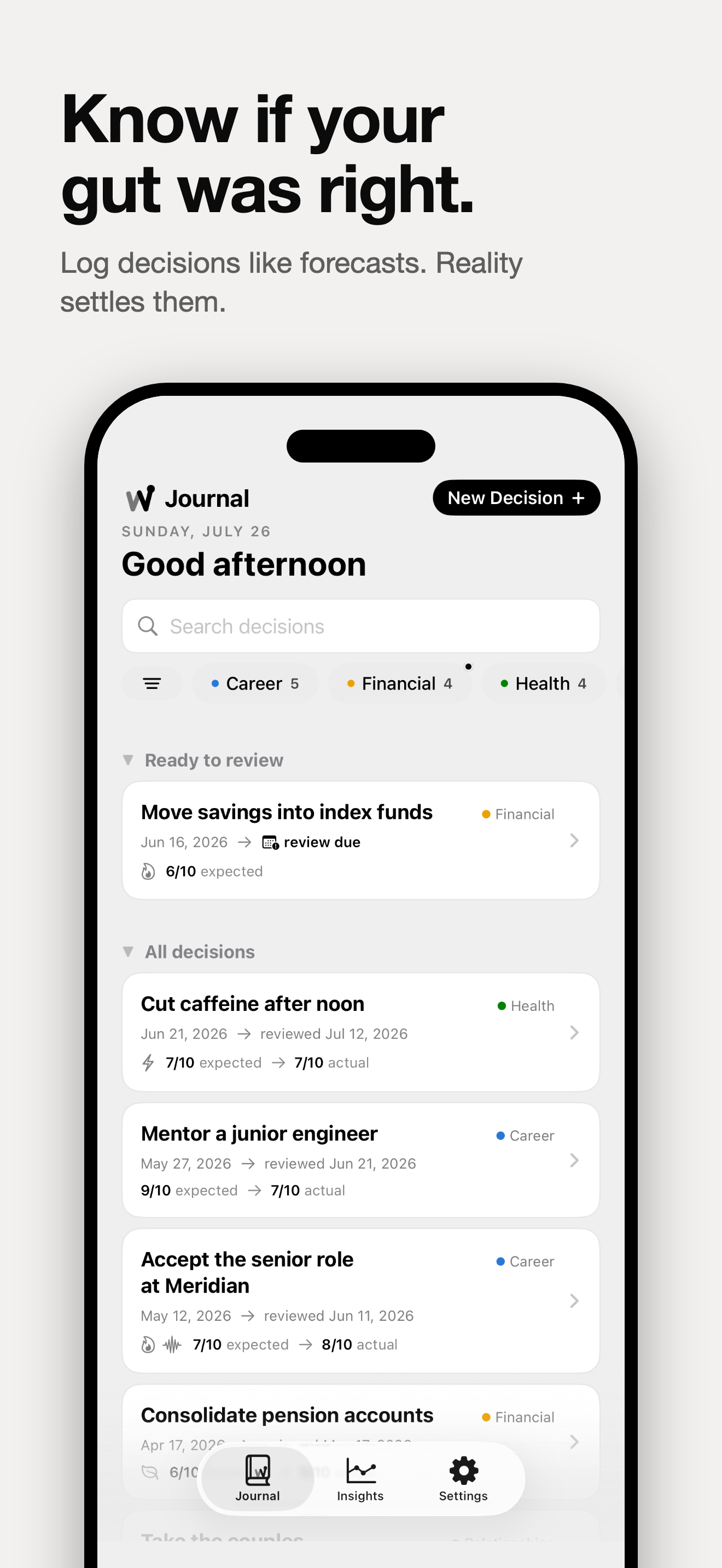
Writ is a decision journal for iPhone and iPad. You record the call before you know how it ends — the options, the odds, your confidence — then Writ brings you back and shows whether your confidence deserves your trust.

Read entry № 001

Coming soon to the App Store.


Entry № 001, in full

This is a finished record, shown whole. The left leaf was written before the outcome. The right leaf was written after. Nothing in between was edited. Note that it is not a success story — the tripwire fired, the ship date slipped, and the gap came out positive. A specimen that admits error is the honest way to show you what the app is for.

Logged — Tue 14 Apr, 08:12

Leaf A. Everything below was written while the outcome was still unknown.

Title

Hire the senior contractor for the rebuild

Situation

Our two-person team is behind on the storefront rebuild. A contractor with strong references is available now at 1.4× our usual rate; a full-time hire could take a quarter.

Options considered

Hire the contractor now60%→ chosen

Wait for the full-time hire30%

Split the work internally10%

Reasoning

Two more months of drift cost more than the rate premium. The references are strong and the scope is already written.

Confidence

70%

Skill vs luck

65 · mostly skill

Expected outcome

Rebuild ships by 30 June; contractor productive inside two weeks.

Stakes

Big call

State of mind

rushed

Tripwire

If no code lands on main by day 10, this was the wrong call.

Tags

hiring · engineering

Review scheduled

30 June

Reckoned — Tue 30 June, 19:05

Leaf B. Written after the fact, against the record on the left.

What happened

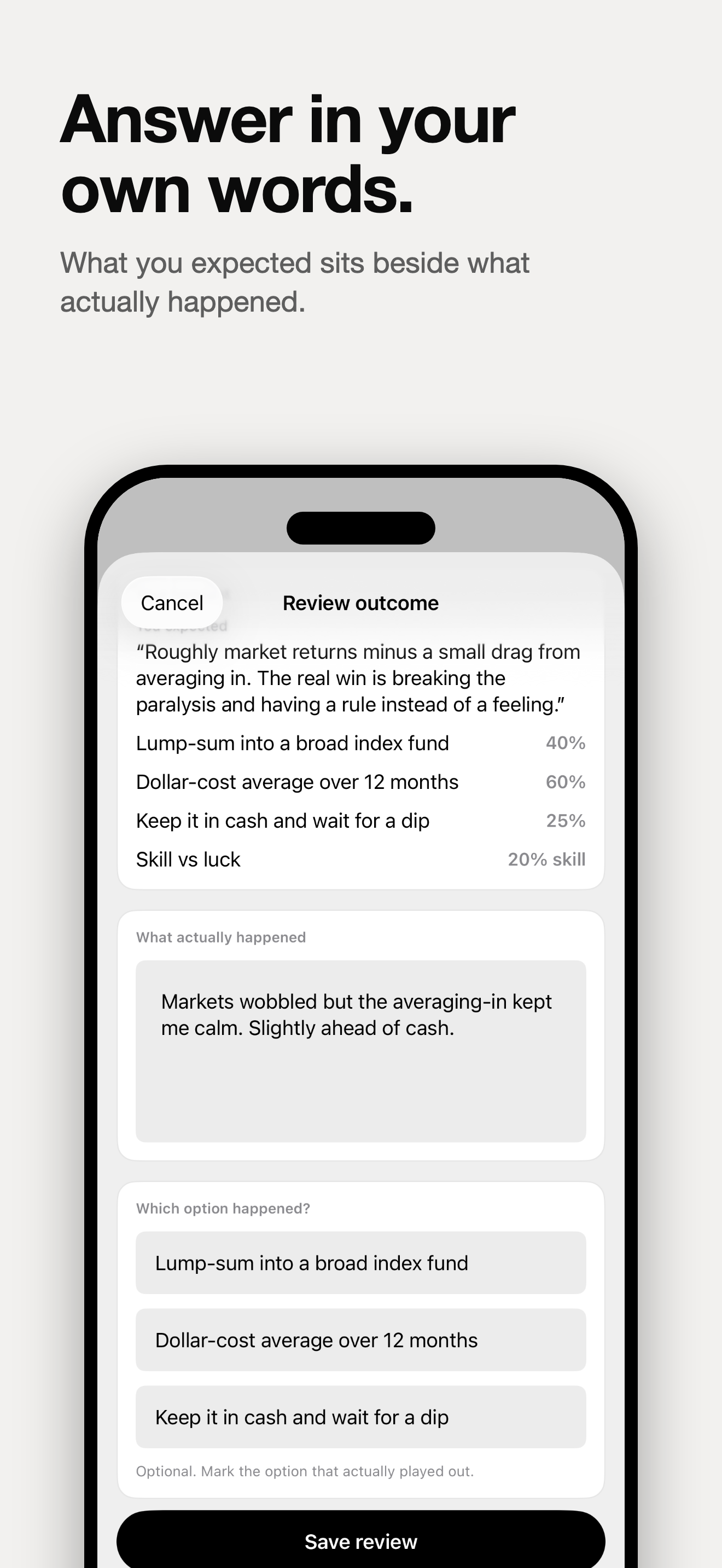
Hired the contractor. Rebuild shipped 11 July — eleven days late; he spent his first two weeks finishing another contract.

Which option occurred

Hire the contractor now

Outcome, rated

55 / 100

Tripwire fired?

Yes — first merge landed day 13.

Reflection

The reference checks measured skill, not availability. Next time the tripwire triggers a conversation, not a note.

70 − 55 = +15

overconfident

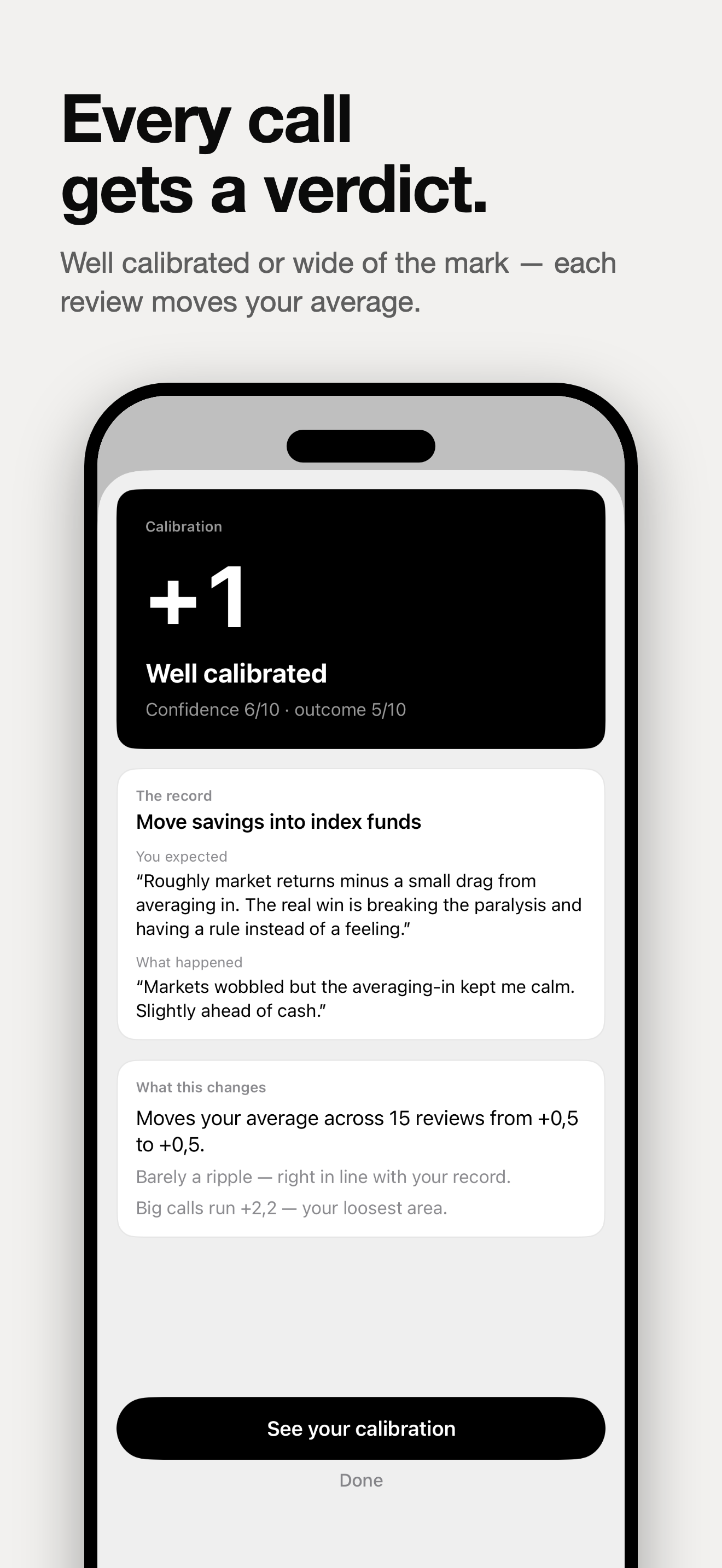
Confidence minus outcome is your calibration gap. Positive means you trusted yourself more than events did. Writ keeps this figure on every entry — and splits it by stakes, mood, and skill-versus-luck.


Memory is a flattering witness.

Once you know how a decision ended, you remember having seen it coming. Hindsight quietly rewrites the reasoning, the odds, even the options you considered. The only defense is a dated record made before the outcome — one you cannot amend after the fact. Writ keeps a single figure on every reviewed entry, and over enough entries that figure becomes a portrait of your judgment.

confidence − outcome = gap

A positive gap means you were overconfident. A negative gap means you were underconfident. Near zero means your word was good.

big calls+15

The gap, split by stakes. Some people are careful with small calls and reckless with large ones. The ledger will say which you are.

small calls4

A negative figure is information too: chronic underconfidence has costs, they are just quieter ones.

entries logged rushed+21

State of mind, cross-examined against results. If your rushed calls run hot, that is worth knowing before the next rushed call.

Specimen figures — your ledger will disagree.

These numbers are a worked example, not a promise. Pro adds the deeper reckonings: Brier score detail, discrimination, learning curve, and forecast horizon.


writ /rɪt/n. a formal written order; judgment with authority. Also: archaic past tense of write.

Both meanings are the product.


What an entry records

№ 004

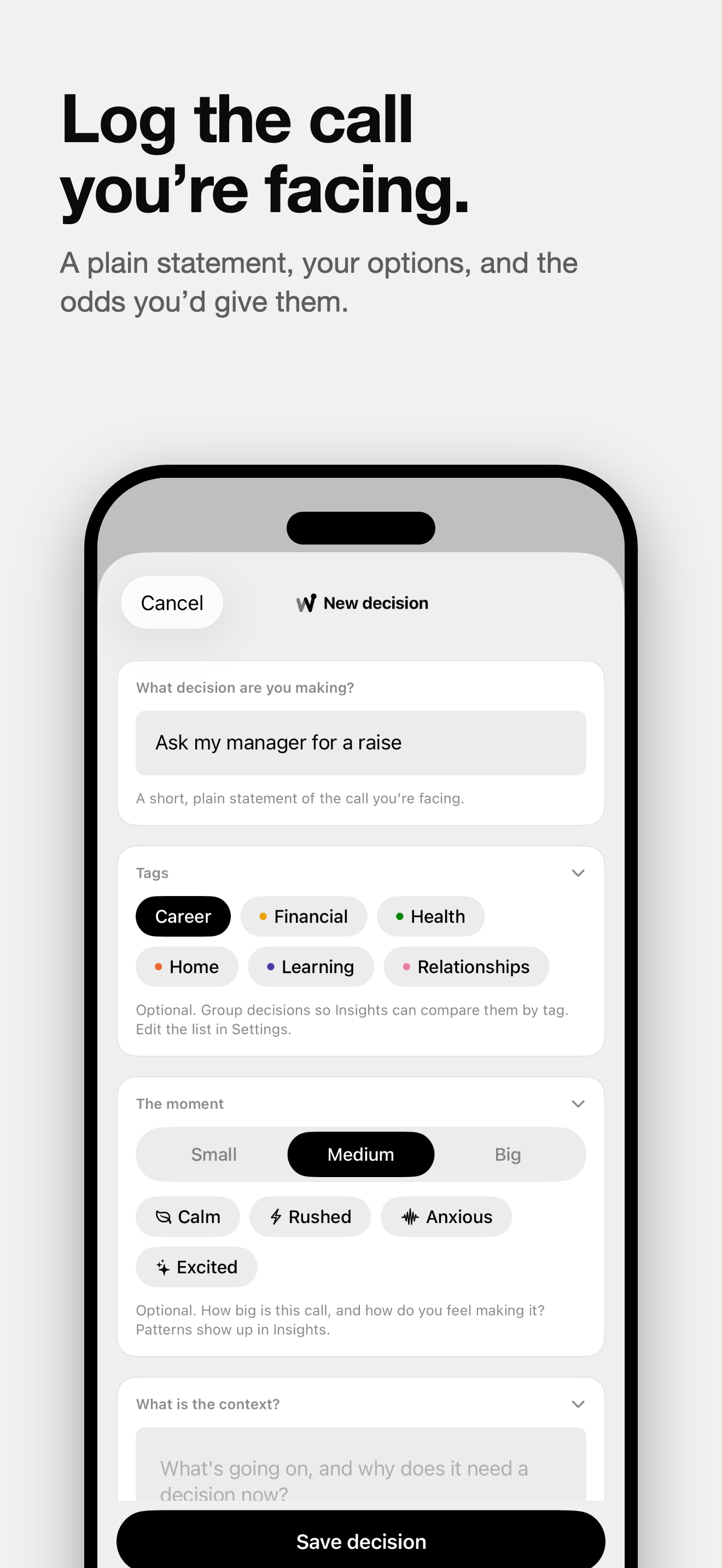
Eleven fields, each there for a reason. An entry takes a few minutes to write and is designed to be read by the one person who will argue with it: you, later.

  1. 01

    Title & situation

    Enough context that a stranger could follow the call. In three months, that stranger is you.

  2. 02

    Options with probabilities

    Each option you considered, with a probability from 0 to 100%. Probabilities make the options compete; probably is not a number.

  3. 03

    The pick & reasoning

    Which option you chose and why, in your own words — the part hindsight most wants to edit.

  4. 04

    Confidence

    Confidence is a promise you can later be held to.

  5. 05

    Skill vs luck

    Your estimate, 0 to 100, of how much of the outcome you control. Skill-versus-luck decides how much the outcome is allowed to teach you.

  6. 06

    Expected outcome

    What success looks like, stated before the fact, so the goalposts stay where you put them.

  7. 07

    Stakes

    Small call, medium, or big call — so your calibration can be split by what was riding on it.

  8. 08

    State of mind

    Calm, rushed, anxious, or excited, recorded as plain ink glyphs. Later, your moods are cross-examined against your results.

  9. 09

    Tripwire

    The early sign that would mean this was the wrong call. The tripwire is written while you are still honest.

  10. 10

    Tags

    So your hiring judgment can be weighed apart from your money judgment.

  11. 11

    Review date

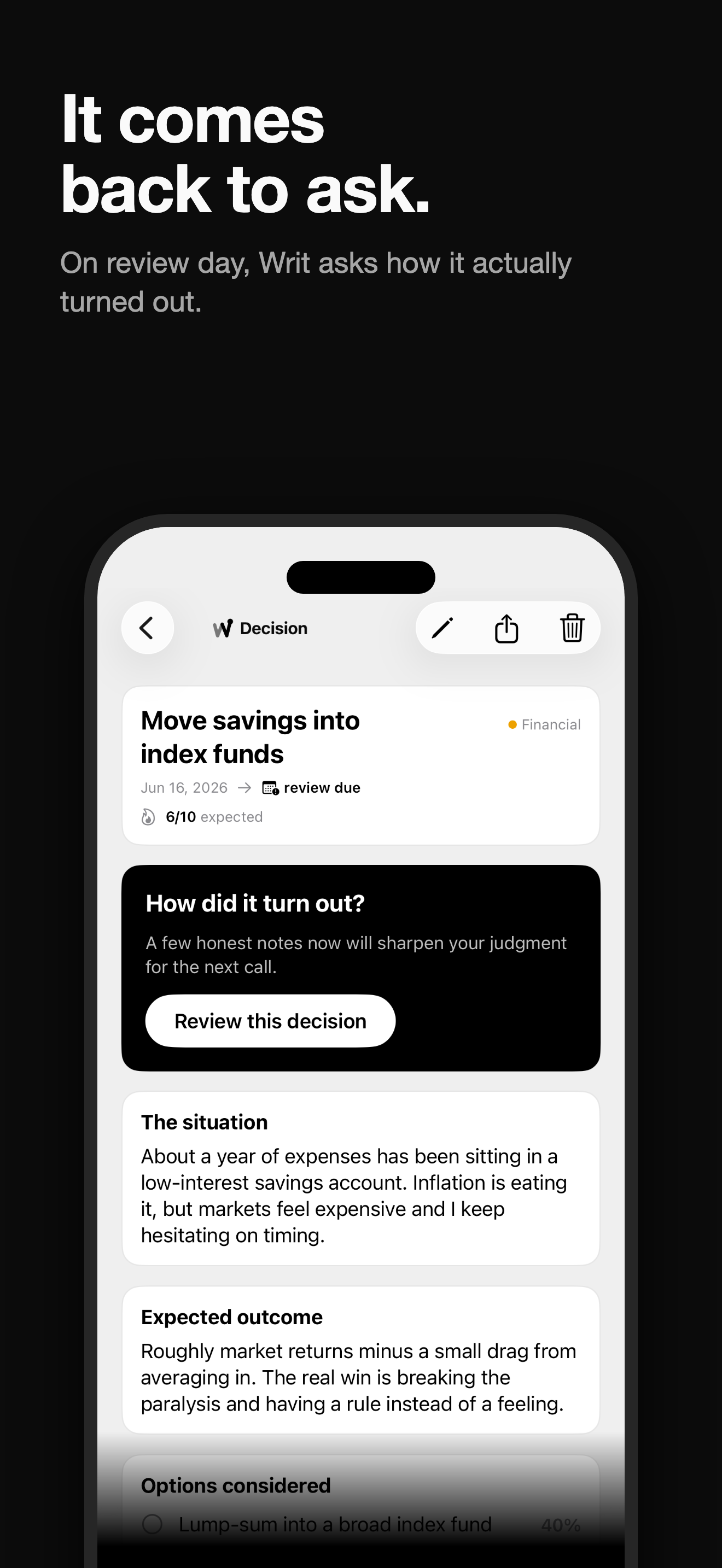
    A scheduled review makes hindsight an appointment, not an ambush.


Two grades of ledger

№ 005

In every copy

A free journal holds five decisions, and the core analytics come with them. Nothing you write is ever taken away or hidden — at five, you simply cannot enter a sixth until you go Pro. Delete one and the slot returns.

  • Five decisions
  • Summary tiles
  • Streak
  • Review rate
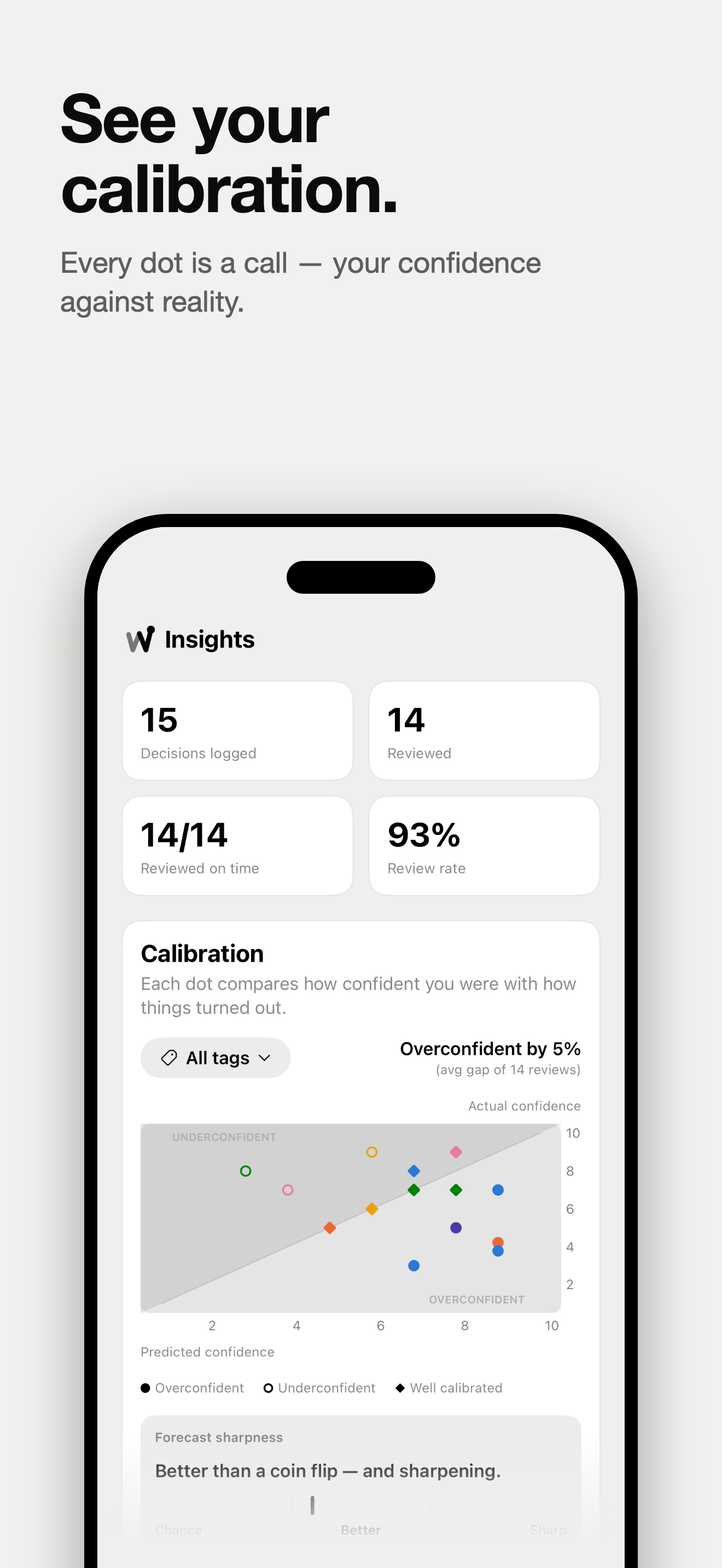
  • Calibration scatter
  • Monthly volume
  • Tag breakdown
  • Outcome trend

In the Pro ledger

Pro lifts the limit and opens the deeper reckoning — an unbounded record, and more ways to interrogate it.

  • Unlimited decisions
  • Brier score detail
  • Discrimination
  • Learning curve
  • Forecast horizon
  • Stakes, mood, and skill-luck breakdowns
  • Tag scorecard
  • Tripwire analytics
  • Highlights
  • PDF and CSV export

Fee schedule

№ 006

A free journal5 entries· no card

Pro, monthly$2.99· 3 days free

Pro, annual· not yet entered

Coming soon to the App Store. The annual figure is not settled, and we would rather leave a blank than print a number we would have to revise.


Kept in your own hand

№ 007

Your worst calls are written in this app, in your own words, with the numbers attached. That is the point — and it is why we built an app that cannot read them.

  1. §1

    No account, no server

    There is nothing to sign up for and nobody to sign in to. We run no back end, so there is no copy of your judgment on our side — because there is no side.

  2. §2

    iCloud, and only yours

    Entries live on your iPhone. If you switch iCloud on, they sync to your own private iCloud database, under your Apple Account, where we hold no keys and can read nothing. Leave iCloud off and they never leave the device at all.

  3. §3

    App lock

    The register opens for you, not for whoever picks up your phone.

  4. §4

    Exports move only when you move them

    PDF and CSV reports are made on the device and go somewhere only when you send them, by your own hand.

  5. §5

    No analytics harvesting

    No analytics, no telemetry, no third-party SDKs. The app cannot phone home about your judgment. It has nowhere to call.

s/

your record needs no witness. we were never holding it.

Read the full privacy policy


Questions, entered and answered

№ 008
Q.1When does it launch?

Writ is pre-launch and coming soon to the App Store. We are not naming a date we would later have to quietly revise — that would be a strange habit for this particular app.

Q.2Why probabilities instead of just writing notes?

Because probably is not a number. Putting 60% where you would have said probably forces the options to compete and produces a figure that can be checked against what happened. A forecast vague enough that it can never be wrong is also vague enough that it can never teach you anything.

Q.3What happens when a review comes due?

A notification arrives on the date you set when you logged the entry. You record what actually happened — including which of your options occurred — rate the outcome, write a short reflection, and answer whether your tripwire fired. Writ then shows the calibration gap: your confidence minus the outcome. It takes a few minutes, and it is the part that does the teaching.

Q.4Who can read my decisions?

You. There is no account, no server of ours, and no analytics. If you switch iCloud on, your entries sync to your own private iCloud database, under your Apple Account — we hold no keys to it and cannot read a word. If you leave iCloud off, nothing leaves the device. Either way, if we wanted to read your decisions, we would have built a very different app. The privacy policy spells this out in full.

Q.5What happens if I never pay?

You keep a journal of five decisions, free, with the core analytics — summary tiles, streak, review rate, calibration scatter, monthly volume, tag breakdown, and outcome trend. Nothing you wrote is ever taken away or hidden from you: at five you keep reading and reviewing everything, you simply cannot enter a sixth until you go Pro. Delete one and the slot comes back. Five is enough to find out whether the habit is for you, and that is what it is for.

Q.6What does it require?

An iPhone running iOS 17 or later. That is the whole list.

Q.7Can I get my records out?

Yes. Pro exports a PDF report or a CSV of every decision, shared from the device by the ordinary iOS share sheet. They are ordinary files, and they are yours.


The next call you make is worth writing down.

№ 009

Writ is pre-launch. If you want to know the day it arrives, leave an address.

Request a launch notice

one email when Writ is entered on the App Store. nothing else.